Are Scratch Cards Worth It?
Are scratch cards worth it? Depends what you're measuring. As a source of income, no scratch card — paper or online — is "worth it" in any mathematical sense: every one is built with a house edge, so the operator keeps a slice of everything staked over time. As a quick, low-stakes bit of entertainment with known odds and an instant result, that's a different question, and one only you can answer for your own budget.
Entertainment, not income
Treat every card as the price of a few seconds of anticipation, the same way you'd treat a cinema ticket — not as a plan for getting money back.
Set a budget first
Decide what you're comfortable spending before you buy a single card, and stop when you hit it — win, lose, or anywhere in between.
The house edge never sleeps
RTP figures below 100% mean the odds are stacked against the player over the long run, by design — that's true of every card on this site.
What "worth it" actually depends on
A card with a higher published RTP returns more, on average, over a huge number of plays than one with a lower RTP — see our odds guide for the real spread we see across the games we review. But RTP is a long-run statistic, not a forecast for your next card. Whether a scratch card is "worth" your money comes down to whether you're happy paying for the experience itself, regardless of outcome.
The maths, in plain terms
Say a card has a published RTP of 92%. Averaged across a huge number of plays, that means for every £100 staked on that specific card, roughly £92 comes back as prizes and £8 stays with the operator. That £8 isn't a fee you pay upfront — it's baked into the prize structure, spread across everyone who plays that card.
On any single card you buy, you might win far more than you staked, or nothing at all; the 92% is what the outcome averages out to once you zoom out far enough that individual luck stops mattering. That zooming-out never happens for you personally — it happens across the whole population of everyone who ever buys that card — which is exactly why RTP tells you about the game, not about your next play.
That distinction matters because it's easy to treat a single card's result as evidence about whether the game is "good" or "bad" odds, when one result — win or lose — tells you almost nothing statistically. The RTP figure only becomes meaningful at a scale no individual player ever actually reaches, which is exactly why it's a number for understanding the game, not a prediction tool for your own session.
If you take one thing from this page, make it that: judge the format by its odds and its entertainment value, not by how your last card happened to turn out.
Physical vs online — the same question, different published figures
The RTP maths above is the online-specific version of this question, because online games are the format that publishes a percentage RTP figure. A paper National Lottery card doesn't print an RTP — instead, it prints the overall odds of winning something and the odds of the top prize, directly on the ticket or the operator's rules page for that game (see our National Lottery guide for real examples).
Both formats are answering the same underlying question — how much of what's staked comes back to players over the long run — they just disclose it differently: online as a single RTP percentage, physical as odds-of-winning plus a fixed prize table. Neither format is more or less "worth it" as a rule; a specific online card and a specific paper card can sit anywhere on that scale, so the format itself isn't the deciding factor — the individual game's published figures are.
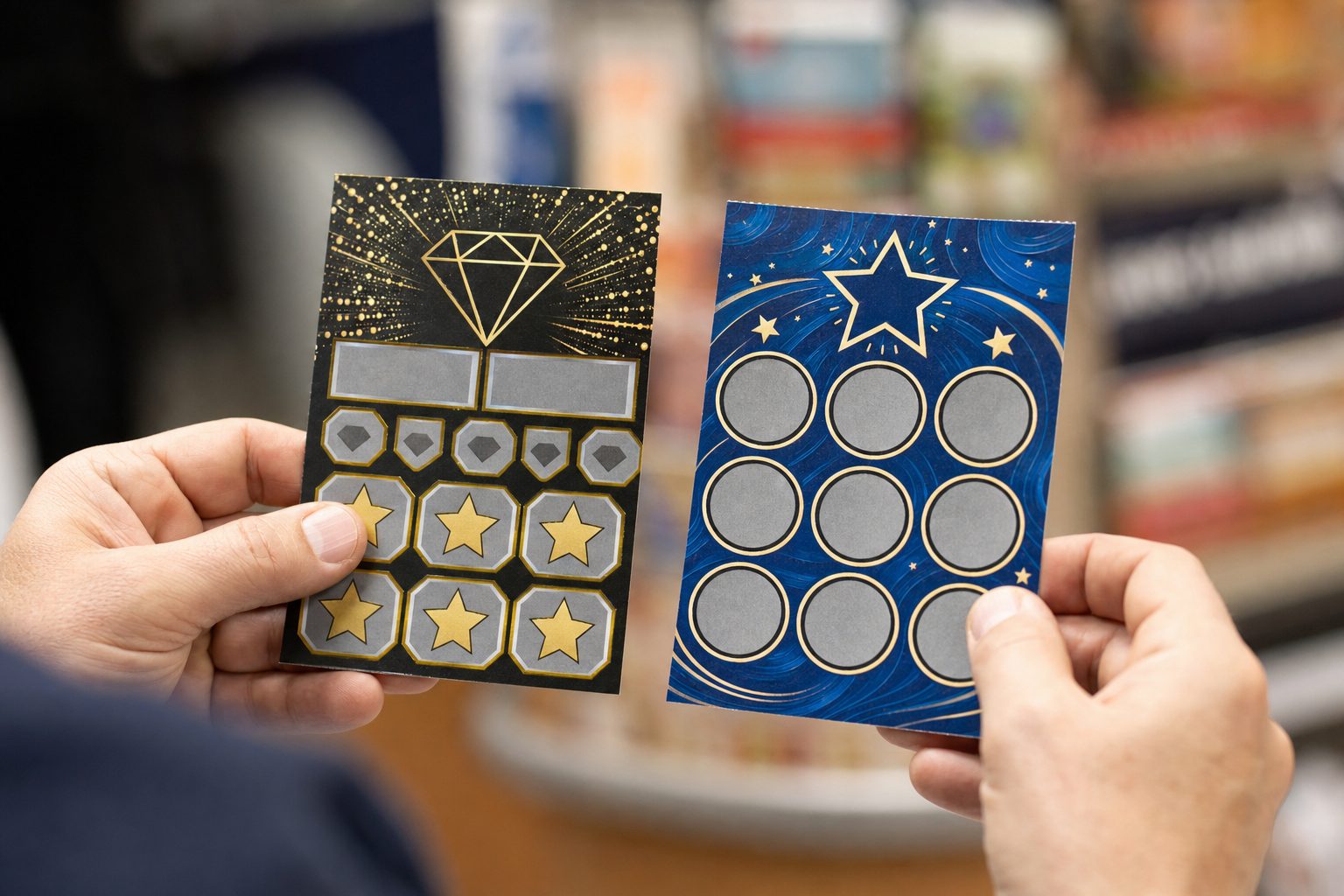
Common ways people talk themselves into a different answer
A few patterns of thinking make scratch cards feel more "worth it" than the maths supports, and they're worth naming so you can spot them in yourself. One is treating a near-miss — two matching symbols and a third that's close — as a sign you're "due" a win; the odds haven't moved at all, because each card's result was fixed before you ever touched it.
Another is counting only the wins when you think back over your play and forgetting the cards that paid nothing, which skews your own memory of how often you actually win. A third is chasing a loss by buying another card "to get back to even" — a decision made from frustration rather than the budget you set at the start, and usually the first sign a session has stopped being fun.
Naming these patterns in advance makes them easier to notice in the moment, which is really the whole point of writing them down here rather than leaving them as vague advice to "gamble responsibly."
Straight answers
Does anyone actually win on scratch cards?
Yes — prizes are real and paid out according to the fixed odds printed on the card or shown in the game's paytable. Just don't expect winning to be the likely outcome of any single play; the odds of the top prize are always the longest of all.
Are more expensive scratch cards more likely to win?
Not automatically, and it depends whether you mean physical or online. For National Lottery paper cards, higher-price tickets tend to carry larger top prizes and often better overall odds — but it's printed on each ticket, so check rather than assume. For online cards, the price you stake per play doesn't move the published RTP either way; a £5 card and a 10p card can carry identical odds, since RTP is fixed by the game itself, not by your stake.
Is there a strategy that improves the odds?
No. Scratch cards are fixed-odds games — the result is set the moment the card or round is generated, not influenced by how, where or in what order you scratch. Any pattern you notice while playing is coincidence, not a system.
How do I know when to stop?
Set your budget before you start and stick to it regardless of what happens. If you find it hard to stop, GamStop and GambleAware (linked in our footer) offer tools and support.
Please gamble responsibly. GambleAware.org 18+